Texas House Bill 1481, which keeps students from using personal communication devices on school property during the school day, has sparked significant debate – especially with students and guardians. The law aims to reduce distractions and improve the learning environment, but it has raised serious concerns about student safety and personal responsibility.
Instructional time and responsibility
The use of phones during the school day is distracting and can make students disengage from instructional time. Proponents of the ban point to a clear link between cell phones and distractions. Teachers and administrators report that with phones put away, student engagement and attention spans improve, leading to better academic outcomes. This perspective argues that removing a major source of distraction, such as a cell phone, allows students to focus more fully on instruction and interaction with their peers.
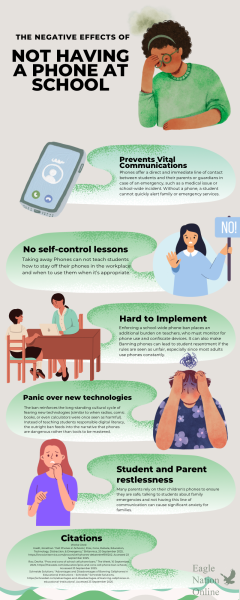
However, this approach is overly simplistic. Administrators claim that by banning cell phones, they are effectively stopping distractions in school, a point made by junior Tejas Konka in his editorial last year. While phones can be a distraction, so can school-issued devices like Chromebooks, which still provide access to games and non-educational content. Instead of teaching students how to manage their attention and use technology responsibly, the ban simply removes the tool. Yes, one can tell a 14-18-year-old that they can’t have any communication device, and you can tell a middle school student that too, but you can’t force that responsibility on them – especially if they aren’t willing to take it. For a generation that grew up with technology as a main part of their lives, this approach doesn’t prepare them for a future where digital discipline is essential for success.
Safety
In the moment of an emergency – most controversially, a school shooting – not all 3,043 Prosper High students would be able to talk to their parents or guardians on a couple of office phones. If all students wanted to talk to their parents, it would take forever to do so. A major concern with the new bill is the potential for a safety crisis. In a school with thousands of students, relying on classrom landlines in the event of an emergency is impractical and dangerous, especially with a school that has a large population. Students and parents have a right to be concerned about communication during a crisis. If a student is in a dangerous situation and can’t use their phone, valuable time is lost trying to find an administrator or another available device. A ban that is intended to create a safer learning environment may, in fact, create a critical communication gap when it’s needed most.
Solutions
Ultimately, while the intention behind House Bill 1481 is understandable, its execution raises more questions than answers. The law shifts the responsibility of managing distractions from the student to the school, while simultaneously creating a potential safety vulnerability. Students and families in Texas should voice their concerns to local officials and find ways to advocate for policies that balance the need for focus in the classroom with the reality of student safety and personal responsibility. Sign petitions online and find ways to make the voice of students’ heard, be sure to reach out to Texas Representatives with emails, letters, phone calls, and more. The best solution that students can implement is to talk out about how this law has affected them, but be sure to know the positive sides of House Bill 1481 as well.
This article has been edited by Trisha Panicker, Kate Duncan and other staff members.