The clock strikes 5:30 p.m. The first whistle of the night blows. Fans anxiously watch players dash across the screen, waiting to see which team will score first. But even after the initial kickoff ends, most families aren’t disappointed – they’re excited. It’s finally time to see this year’s round of Super Bowl commercials.
Usually, that’s the sentiment for many Americans. This time, instead of fanfare and harmonious chatter surrounding the commercial breaks on social media platforms, the event hasn’t resulted in much positive conversation — if anything, it has only led to disappointment from many viewers. The championship between the victorious Seattle Seahawks and New England Patriots took place on Feb. 8 at Levi’s Stadium in Santa Clara, California. While the match, though more of a defensive battle than an aggressive one, was received relatively positively — depending on who you were rooting for, of course — the much-anticipated commercials fell surprisingly flat due to a multitude of reasons.
“The AI Bowl”
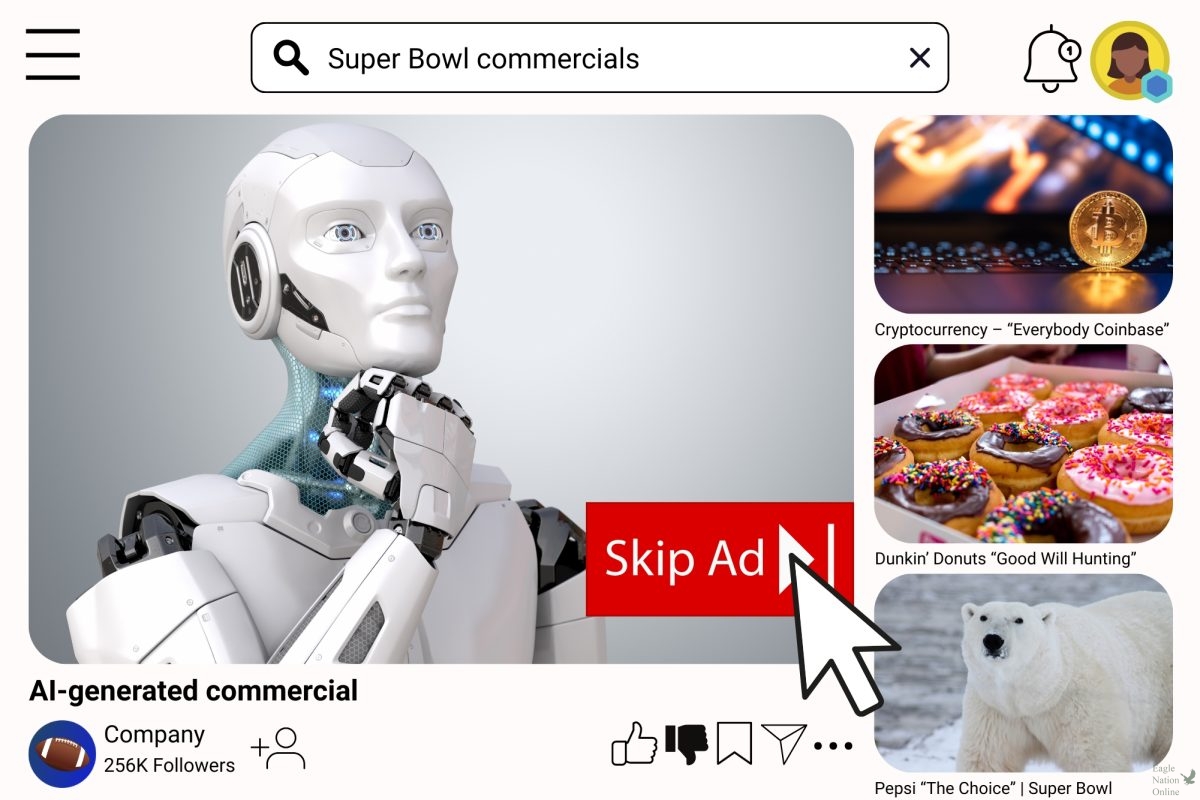
A glaringly obvious difference between this year’s Super Bowl commercials and last year’s is mainly one thing: the presence of artificial intelligence. Svedka, a vodka company, produced an ad entirely made of AI, which ironically featured two robots, Fembot and Brobot, beaming as they danced along to “Super Freak” by Rick James. In a less apparent route, Dunkin’ Donuts‘ parody of drama film “Good Will Hunting” seemed to use AI-powered de-aging technology on celebrities like Jennifer Aniston and Matt LeBlanc in an attempt to capitalize on the nostalgia of the viewers at home. Other ads, while not utilizing AI directly, promoted their own versions of the technology instead. For their commercial, OpenAI showcases how ChatGPT can help people with their day-to-day functions or goals. In a small contrast, Anthropic humorlessly bashes OpenAI in their own commercial by highlighting the nonhuman way ChatGPT generates dialogue, but still promotes their own chatbot nonetheless.

People aren’t calling the event the “AI Bowl” for no reason. One or two commercials created with AI? That would have been disappointing, sure, but manageable. 15? That’s 23% percent of all advertisements shown during the event, according to The New York Times. That isn’t to say that the entirety of these advertisements were made using this technology, but nearly a quarter of them is more than enough to not go unnoticed. This excessive use is lazy and, frankly, unprofessional. The Super Bowl commercials are supposed to be the best of the best, not just because they look nice or have the capability to tug on one’s heartstrings, but because they were made by humans. By taking people out of the equation, the entire point of what made the mass marketing so celebrated in the first place is greatly undermined.
Dystopian doorbells
By far, the most eerie commercial of the bunch has to go to Ring‘s search party installation. The segment is framed as a heartwarming story about a family using the company’s new AI-enabled feature to find their lost dog, harnessing the ability to scan the entire community via the process. This, understandably, resulted in heavy backlash from viewers, fearing a dystopian misuse of the technology. In a time when surveillance technology is already deeply intertwined with law, immigration enforcement, this reaction is very reasonable — who’s to say what these devices could be capable of, and what other purposes they could be used for?
After hefty amounts of backlash towards the advertisement, Amazon, the parent company of Ring, has since cut ties with the police surveillance tech company Flock Safety. The tech company, Flock Safety, provides several systems, like AI-enabled license plate reader cameras and audio detection devices to law enforcement, neighborhoods and businesses, in an effort to increase security while lowering crime rates. Though Flock Safety was not directly featured in the commercial, the depiction of the widespread AI surveillance was enough of a spark that led the company to end the partnership, and rightfully so. With this cancellation, you can get a good idea of what the Ring technology was going to centrally be used for, and the undertone of the commercial stays just as — if not more — strange than it was before.
Advertising something as powerful as neighborhood-wide scanning technology during one of the most-watched broadcasts of the year, without directly addressing its impacts, raises serious ethical concerns. Safety is important, yes, but so is the privacy and priority of American citizens, which should be the main values of the companies producing these commercials.
Unhealthy health promotions
In addition to the ethical questions raised in regard to AI use and surveillance, another major oddity present during the commercial breaks of the event was the sheer amount of health-positive — or rather, health-negative — messages. While these normally would be acceptable and received positively, many of these commercials missed their goals by a mile. A major point to these commercials was centered around weight loss, either shaming people for their stature or promoting drugs to do so. A large example of this was Ro’s commercial, featuring Serena Williams promoting the company’s GLP-1 weight-loss medication. In addition, Make America Healthy Again (MAHA) showcases Mike Tyson recounting his previous obesity with self-loathing language, but later flips the script and targets other people who are currently in these situations.
In what world are these commercials fit to air on television? The broadcasting of Mike Tyson’s commercial is harmful to a multitude of communities that are susceptible to his words, and Serena Williams — one of the greatest athletes of all time — promoting a weight loss drug as if it were a direct cause of her fitness is misleading and damaging to anyone who viewed the advertisement. Using professional athletes to endorse these misconstrued messages is dangerous and goes far beyond simple testimonies.
In conclusion
The Super Bowl commercials for this year, however, were not totally irredeemable. There were some notable commercials among the batch, like Pringles‘ humorous one featuring singer Sabrina Carpenter building her perfect man out of the chips, and Emma Stone’s Squarespace commercial depicting the actress in anguish after discovering the domain of her name was already taken, directed by longtime collaborator Yorgos Lanthimos in a film-noir style. Both of these advertisements represent creativity that would have been wonderful to see more of throughout the event.
In the long run, this year’s round of commercials left a large impact on viewers — both good and bad. AI advertisements swept the board, segments perpetuating harmful rhetoric regarding weight managed to slip through the cracks, and on top of this, viewers had to worry about their privacy after watching the Ring commercial. In short, these commercials were disrespectful, harmful and patronizing to Americans who had been looking forward to them. Let’s hope that next year will bring a more creative batch of promotions to our TV screens instead of what we were given for the 60th Super Bowl.
This article was edited by Polly Greaves, Landon Byrom, and Ethan Chatelain.