
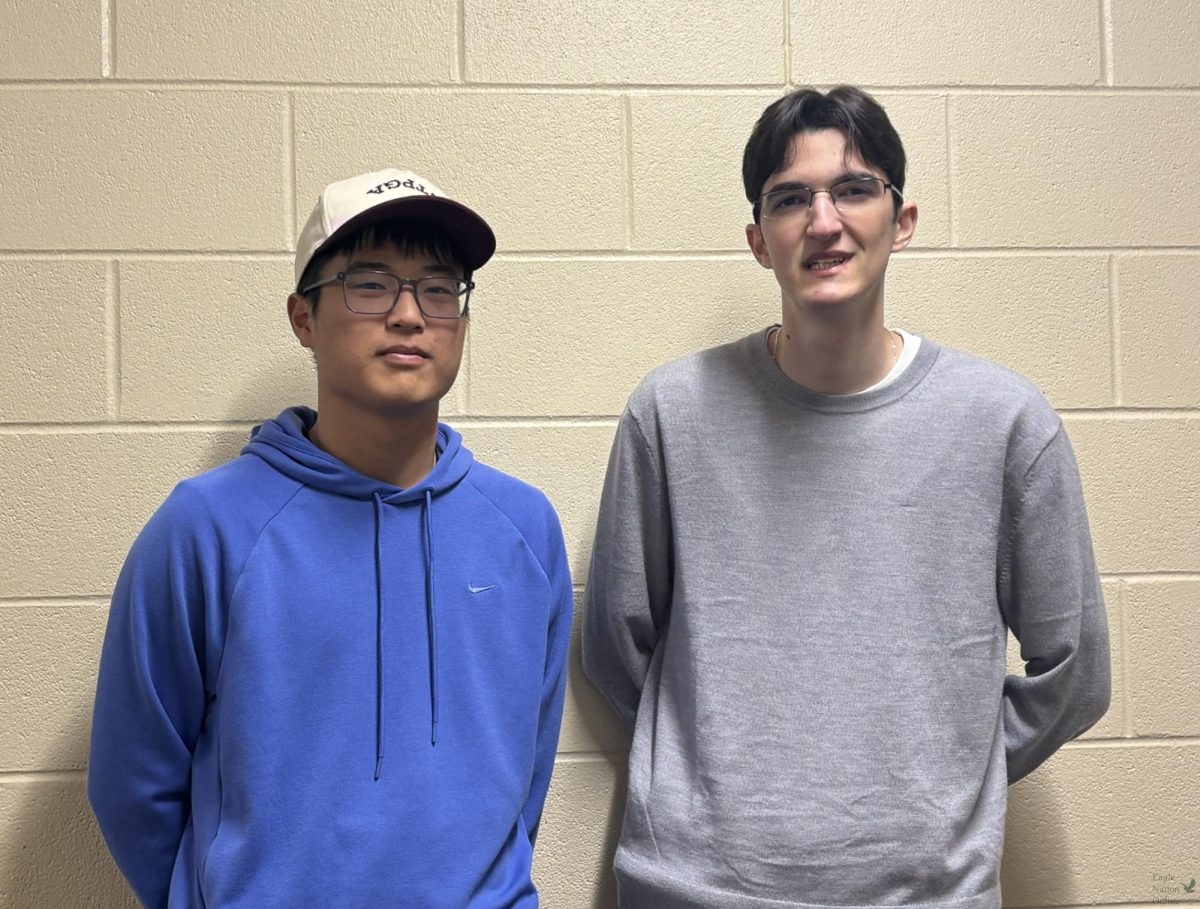
Every week, seniors Yunjae Park and Ron Minin met in the library to work on their big project. This wasn’t for a school assignment, instead it was something bigger than the both of them — an artificial intelligence chatbot named Edgy.
What started out as just a theoretical idea in their computer science class during their sophomore year has now evolved into a complex AI project that both want to take outside of the school and into the Prosper community.
“There came a point about a year and a half or a year ago where we were like, ‘Let’s make something kind of bigger than what we’ve been making,’” Park said. “And we also wanted it to be something that people can actually use and benefit from, and we also wanted it to be related to our surroundings. So we started coming up with ideas. School is like our main environment, so we felt like making this would impact our community in a good way.”
Edgy AI can answer questions exclusive to Prosper High School, including the classes and clubs it offers.
“We wanted to make (Edgy AI) kind of specific to this place,” Park said. “If students, parents or staff want to find something or they need an answer to their question, (and) maybe they can’t find it on the website, or it’s hard to find, (Edgy AI will) make it easier and faster to find those things.”
Park and Minin also focused on making the chatbot accessible to all devices, even school-issued ones.
“It’s basically a website,” Park said. “If you have the link, you can access it anywhere. You can access it on a Chromebook, too.”
Edgy AI was trained utilizing a similar process used for mainstream chatbots like ChatGPT.
“Our application differs because we try to get specific data from the school,” Minin said. “We take the data that we have, and then we use the input and we try to find more specific stuff. And then
we pair it with a language model so we can get human-like sentences.”
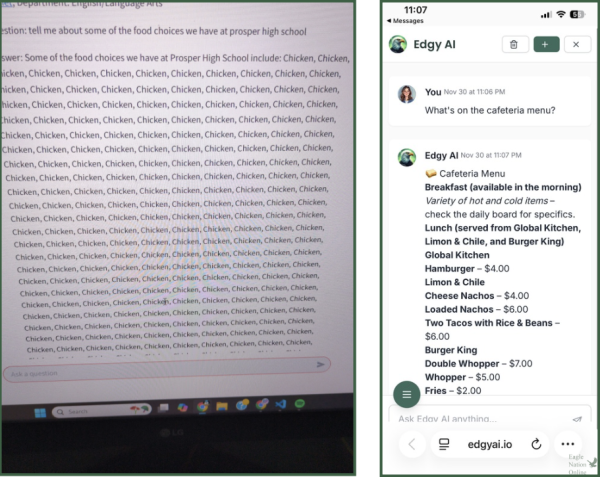
On their path to deploying the finished AI application, the two said they faced some “dark times” in which the program gave out glitched answers.
“There were times where it was like spewing out Chinese emojis,” Park said. “There was one time where we asked for a lunch menu, and it repeated the word chicken like 900 times. And we have a screenshot for that. It’s kind of funny.”
However, using the internet as their main resource, they were finally able to get Edgy AI functioning normally after checking in the code and getting it ready to deploy.
“We eventually got it working with like logic, and it would give good responses,” Minin said. “Our application kind of became so big that it was hard to deploy to the Internet. And we had to make like a hundred different commits, like a hundred different changes just to get it to work online.”
This project stemmed from Minin and Park’s shared interest in computer science. For Minin, it developed at the start of his high school career.
“I started coding in ninth grade,” Minin said. “And just making small projects like rock, paper, scissors, tic-tac-toe. I took courses and went to (summer) programs. I also took the AP Computer Science course at our school. Any time I have off, I like to code some stuff with AI. I’m interested in computer vision. I like natural language processing also.”
Park’s interest stayed with him for his entire life. When he entered high school, he took it more seriously when he started to make small coding projects. His attention towards AI came soon after.
“AI really got into my mind about two or three years ago,” Park said. “And then I really wanted to learn how it’s possible for something to talk like that, or like how does it understand things. So that’s where I started to take courses. I also made a worship song recommender for my church. I play drums for my church, and we used to have troubles picking up worship songs. And I think that helped me understand that this can help a lot of people everywhere.”
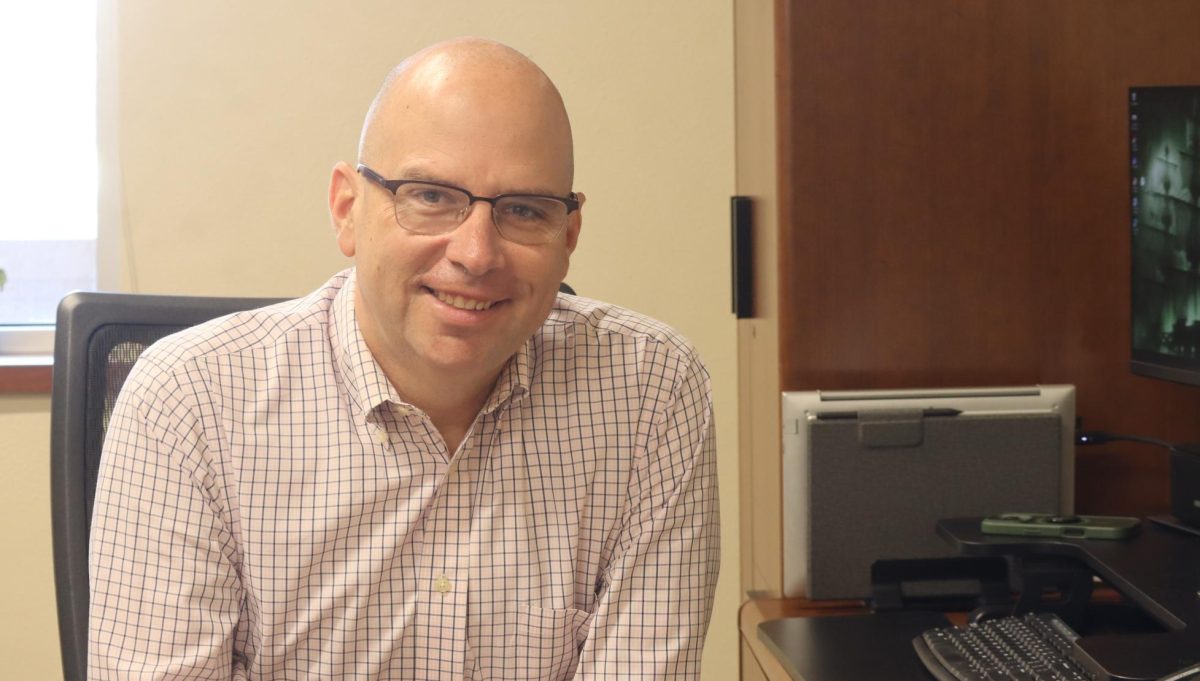
Having both students for AP Computer Science A and writing their recommendation letters, computer science teacher Brian Singleton helped nurture their interests and observed the project’s evolution.
“They’re inquisitive,” Singleton said. “They define problems and try (to) figure out how they work and that kind of stuff. If they weren’t in class, (which) it was rare, I knew that if they had a problem, they would ask.”
Almost a month after Park and Minin deployed Edgy AI, the two now want to focus on spreading it to the community. They want to grow its use as their own project through Instagram since Prosper ISD hasn’t officially endorsed it.
“We’re seniors right now, so hopefully we can get it to a point where we can maybe make a team with others, and they can continue updating it,” Minin said. “Because every year, there’s new teachers, new courses. And we are looking to automate the database updates. It can even expand beyond Prosper.”
Reflecting back on the whole experience, both students said they followed through with this idea to improve their learning and benefit their community.
“We’ve just tried to work together as a team,” Park said. “We just had a goal in mind and just wanted to do it for ourselves.”
This article was edited by: Kate Duncan, Grace Suzuki, Aarushi Rana and Srinitha Arikati.